

The History of Castel Sant'Angelo in Rome
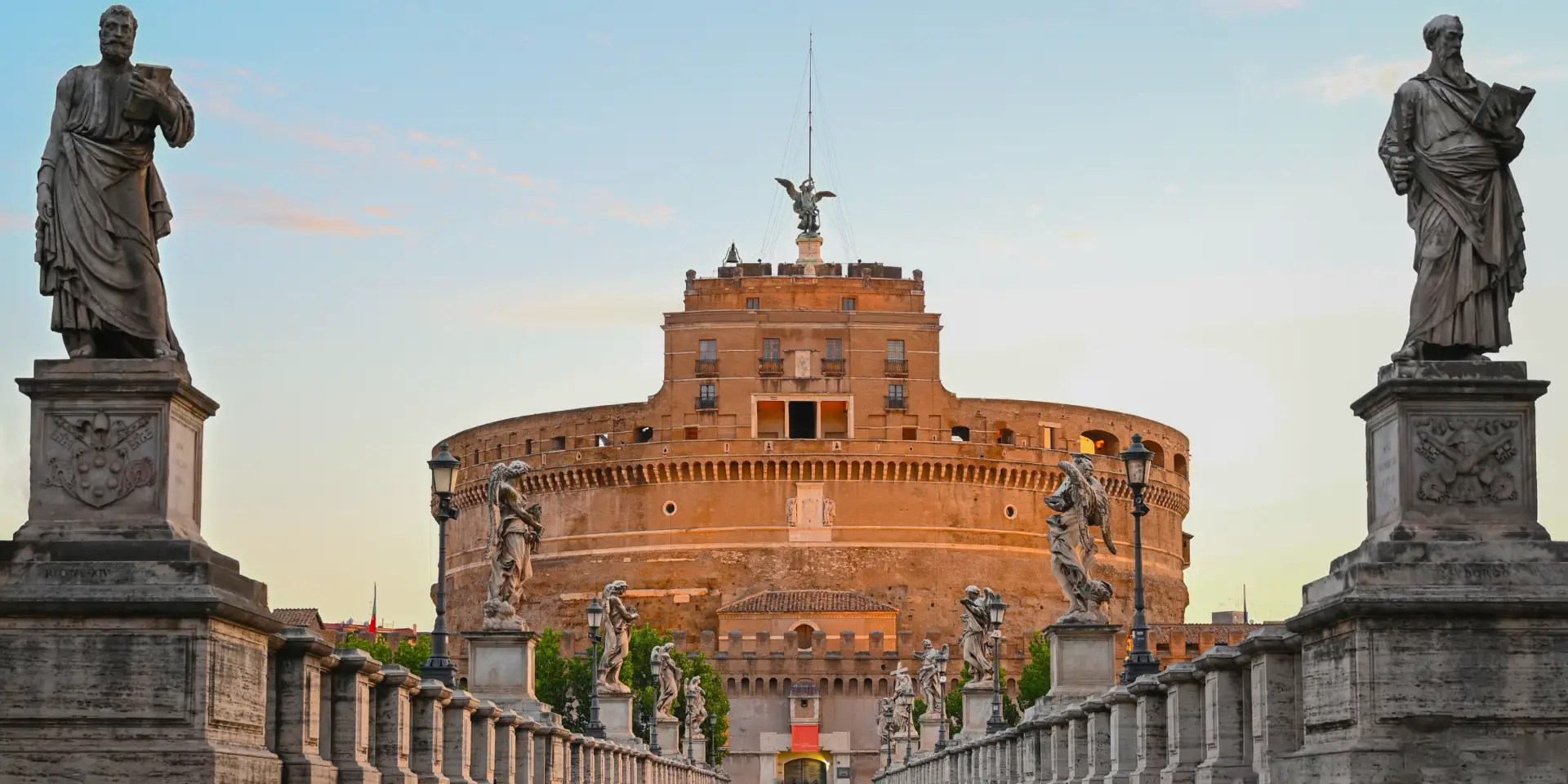
Walking along the Tiber, especially at night, one inevitably encounters the breathtaking sight of an enormous mass of bricks and stones, crowned by the silhouette of the Archangel Michael with outspread wings. This is Castel Sant’Angelo, an ancient papal fortress that is definitely worth a visit both during the day and after sunset, as in both cases, one can glimpse the surreal beauty of its nineteen centuries of history.
The Archangel and the Plague: The Statue of Castel Sant’Angelo and Its Legend
The fortress takes its name from an ancient legend dating back to the Middle Ages. In the late 6th century AD, following the fall of Rome but before the Renaissance era, a terrible plague struck the city. Thousands of people fell ill, and the streets were overrun with the bodies of the dead. As a result, Pope Gregory the Great led a procession, praying to God to spare those who were still alive. As the Pope raised his eyes toward the old mausoleum of Emperor Hadrian, which had long fallen into disuse and ruin, he had a vision of a radiant figure atop the enormous tomb. It was an angel shining brightly and wielding a sword. As the Pope watched, the cherub sheathed its weapon. The meaning was clear: the plague had ended, and God’s wrath was appeased. Today, the statue atop Castel Sant’Angelo commemorates this very legend. However, the current bronze version dates back to the 1700s and replaces an older marble one that once stood in the same spot. The sculpture of the Archangel Michael serves as a reminder to the people of Rome that God’s mercy is ever-present, even when things seem to be at their worst.
The Mausoleum of Hadrian: The Burials at Castel Sant’Angelo
Long before Castel Sant’Angelo was controlled by the Church, it was a significant monument dedicated to the pagan emperors of Rome. Hadrian, one of the greatest rulers of the High Empire, commissioned the construction of a massive cylindrical tomb to rival that of his illustrious predecessor, Augustus. Today, visitors can still reach the main burial chamber via a huge winding ramp that snakes through the imposing concrete structure.
Upon entering, one first passes through an antechamber (once covered in precious marble) where a niche once housed a colossal statue of Hadrian himself. From there, the ascent along the giant ramp begins. As one moves deeper into this immense mountain of bricks and cement, it feels like descending into the underworld, even though the path is technically uphill. Finally, one reaches the heart of the structure: the emperor’s burial chamber. Although nothing remains of its once-rich decoration, the spaces reserved for the sarcophagi of the imperial family are still visible. Remarkably, a single fragment survives—a porphyry lid, possibly belonging to Hadrian’s own sarcophagus, which today, inverted, serves as the baptismal font of St. Peter’s Basilica.
Burials at Castel Sant’Angelo continued throughout much of the High Empire. Most of Hadrian’s successors were laid to rest there, including Marcus Aurelius and the infamous Caracalla.
From Monument to Fortress: The Post-Roman History of Castel Sant’Angelo
The urban landscape of Rome saw little transformation during the medieval period. The inhabitants of this era made use of what the ancients had left behind. Castel Sant’Angelo, in particular, was regarded as an artificial mountain with steep walls towering over 48 meters high. As a result, Hadrian’s once-grand mausoleum became an ideal defensive stronghold. The emperor had strategically built it on a bend in the river to maximize visibility, and for the papacy, which was constantly under attack, it was the perfect fortress.
The transformation of the tomb, however, happened gradually. Many of its fortifications were completed under Pope Alexander VI, and its interior decorations became increasingly opulent under his successors, including Pope Leo X, who commissioned Michelangelo to design the façade of an internal courtyard.
In the 6th century, Castel Sant’Angelo was used as a prison by order of the sovereign Flavius Theodoric and remained so until the first half of the 10th century. Later in the same century, the fortress was controlled for nearly 100 years by the powerful Crescenzi family, who further reinforced it. For this reason, Castel Sant’Angelo is also known as Castrum Crescentii.
By the late 1500s, its interior had undergone significant changes, resembling more of a palace than a fortress. During the summer months, the Pope would retreat there to enjoy the cool breezes from the Tiber. Despite these embellishments, the structure retained its military function and remained the last refuge of the papacy.
The most famous defensive feature of Castel Sant’Angelo was the so-called Passetto di Borgo, a hidden corridor linking the fortress to the Vatican. In 1527, when Rome was sacked and nearly the entire Swiss Guard battalion was massacred, Pope Clement VII managed to escape through this very secret passage.
The Spectacular View from the Top of Castel Sant’Angelo
After ascending through an ancient tomb, medieval fortifications, and lavish Renaissance chambers, visitors who have explored the different historical periods that shaped Castel Sant’Angelo can finally reach its pinnacle. Just beneath the famous statue of the angel, the summit of the monument features a vast terrace offering a breathtaking panorama of the entire city—one of the most spectacular views in all of Rome.
 English
  German
  French
  Spanish
  Portuguese
  Polish