
What to See in Castel Sant’Angelo: The National Museum
Rome, a city that dominated much of the Mediterranean throughout history and left its everlasting mark across Europe, is home to some of the most significant museums in the world. These exhibition spaces showcase artifacts and artworks spanning multiple eras—think of the Capitoline Museums, the Vatican Museums, and the National Museum of Castel Sant’Angelo. Architecturally, Castel Sant’Angelo is a remarkable engineering feat, which also includes the famous Passetto di Borgo. Added to this is a fascinating collection of historical and archaeological artifacts, making the ancient Mausoleum of Hadrian a must-visit destination for anyone exploring the Eternal City.
National Museum of Castel Sant’Angelo: What to See
The National Museum of Castel Sant’Angelo was officially established in 1925 and houses an extensive collection, including paintings, period furniture, sculptures, memorabilia of the Italian Army, and exhibits dedicated to the Girandola fireworks display, showcased in the Sala del Castellano.
Each artifact in the museum is linked to specific historical periods that shaped the origins and evolution of what was once Hadrian’s Mausoleum. The Roman Emperor Hadrian ordered its construction between 123 and 134 AD to serve as a monumental tomb for himself and his family. Over time, the mausoleum also housed the ashes of other Roman emperors, the last being Caracalla.
As centuries passed, Castel Sant’Angelo transformed into a fortress, fought over by various medieval noble families such as the Orsini, Crescenzi, and Perleoni, before eventually becoming papal property and a papal residence.
Visiting the National Museum of Castel Sant’Angelo is like taking a journey back in time to ancient Rome. For example, along the Cordonata of Pope Paul III, which connects the entrance of the mausoleum to the Marcia Ronda, visitors will find two niches housing busts from the 2nd century AD—one depicting a togatus (a man wearing a toga) and the other a portrait of Emperor Hadrian himself. The Cordonata was designed by Crispo Tiberio, the castle warden under Pope Paul III Farnese.
In the Ambulacro of Boniface IX, located between the outer walls and the main structure of the mausoleum, visitors can see the remains of an ancient Roman pavement and a Roman-era base. Also worth noting is The Parlatoio, a room leading to the historical prison cells, where prisoners were once interrogated. A grate in the floor reveals the remnants of Roman walls, while display cases showcase instruments of torture used in the past to extract confessions—whether truthful or not.
The Artworks Inside the Museum
A guided tour of the National Museum of Castel Sant’Angelo includes a visit to the Sala Paolina, which houses the most important decorative cycle of the 16th century, painted by Perin del Vaga. Here, visitors can admire depictions of Alexander the Great in various scenes of his life, the Archangel Michael, Emperor Hadrian, and impressive trompe l’oeil works.
In the Sala Clemente VIII, visitors can view massive doors from the Armory of Clement X, which was once attached to the Bastion of St. Luke. This room also houses the portal of the Sala della Giustizia (Hall of Justice), where Giordano Bruno was sentenced to death for heresy, as well as a monumental fireplace decorated with the Barberini family’s coat of arms.
Continuing the tour, visitors reach the Chapel of Leo X, a small and simple space featuring its most prized possession: a bas-relief by Raffaello da Montelupo, depicting the Virgin Mary with the Christ Child.
One of the most fascinating rooms inside Hadrian’s Mausoleum is the Sala di Perseo (Hall of Perseus). Here, frescoes narrate the mythological feats of Perseus, as told in Ovid’s “Metamorphoses”. This room displays remarkable artworks, including St. Jerome by Lorenzo Lotto, St. Onuphrius, Christ Blessing by Carlo Crivelli, and the Lamentation over the Dead Christ, a 15th-century wooden sculpture from the Lombard school. The sculpture portrays Jesus, just taken down from the cross, surrounded by mourners grieving his death.
The Sala di Amore e Psiche (Hall of Cupid and Psyche), filled with sensual depictions, was originally the bedroom of Pope Paul III Farnese. Among the displayed works are The Bath by Giovanni Luteri (known as Dosso Dossi) and Christ Bearing the Cross by Paris Bordone.
Among the other masterpieces housed in the National Museum of Castel Sant’Angelo, notable mentions include:
The Feast of the Gods (a copy of the original by Giovanni Bellini, exhibited at the National Gallery of Art in Washington, D.C.)
Young Woman with a Unicorn by Pietro Longhi, gazing directly at the viewer
Portrait of Prospero Farinacci by Cavalier d’Arpino
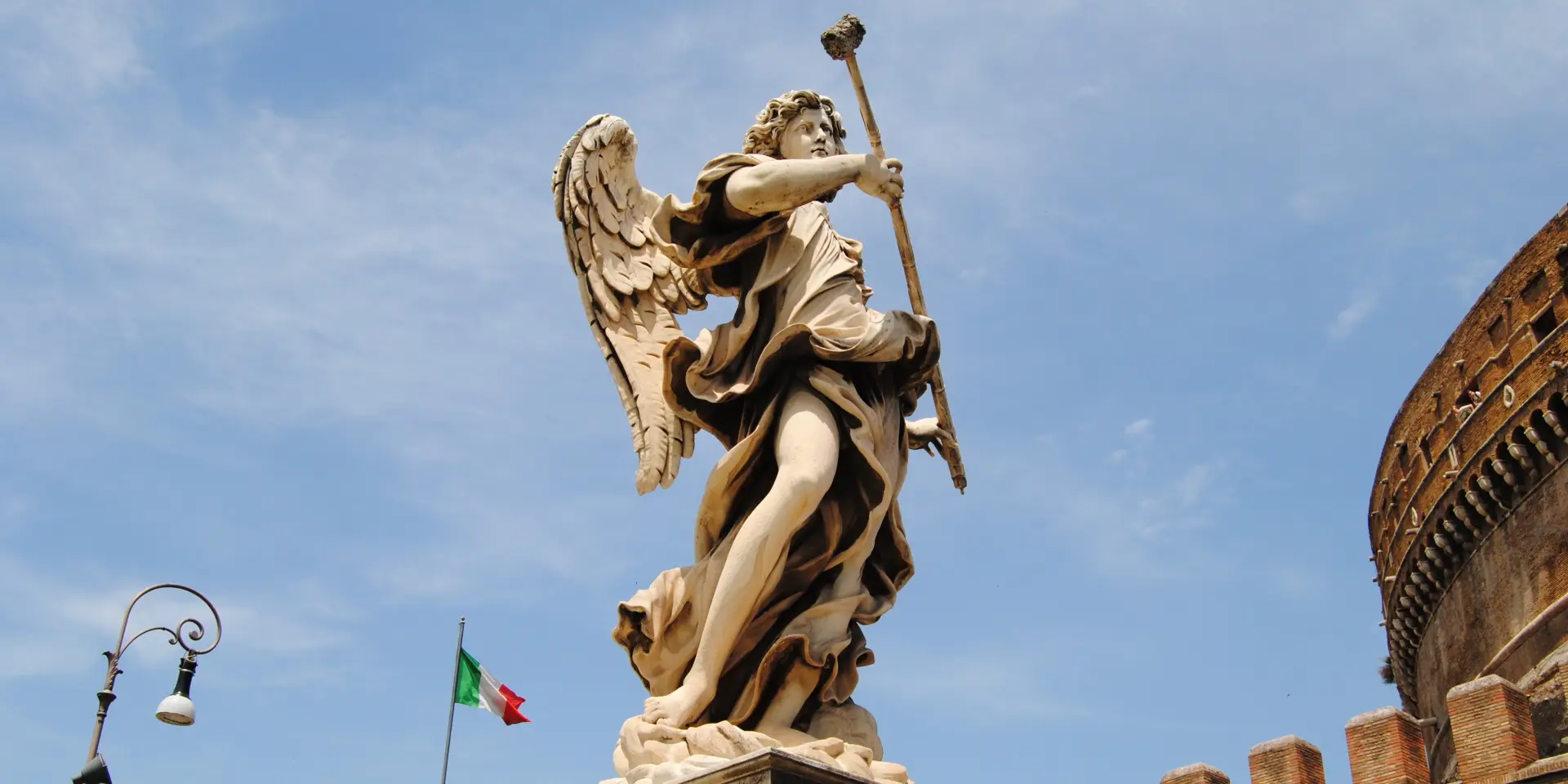
The guided tours of the National Museum of Castel Sant’Angelo also include a stop at the Terrazza dell’Angelo (Angel’s Terrace) to see the bronze statue of the Archangel, created in 1753, and the bell, which was tolled before every execution carried out at the castle.
Finally, the Armory contains military artifacts, including:
A dagger scabbard belonging to the Landsknechts
The Bolzano Helmet, a Saxon-made piece of craftsmanship
A banner of the Bombardiers, who were stationed at Castel Sant’Angelo
A Garibaldian uniform
One of Giuseppe Garibaldi’s pistols
A visit to the National Museum of Castel Sant’Angelo is an unmissable journey through Roman history, art, and military heritage, offering an unforgettable experience in the heart of Rome.
Useful information
Address: Castel Sant’Angelo is located at Lungotevere Castello, 50, 00193 Rome, Italy, just a short walk from St. Peter’s Square and Rome’s historic center.
Opening Hours: The castle is open daily from 9:00 AM to 7:30 PM, with the last admission at 6:30 PM. Please note that the site is closed on January 1st, May 1st, and December 25th.
Ticket Office: To avoid queues at the entrance, it is highly recommended to purchase your ticket online.
How to Get There:
- By Metro: The nearest stations are Lepanto or Ottaviano (Line A), from which the castle can be reached with a short walk.
- By Bus: Lines 23, 40, 62, 271, and 280 stop nearby.
- By Tram: Line 19 stops at Risorgimento/San Pietro, just a few minutes’ walk from the castle
How to get there
To reach the National Museum of Castel Sant’Angelo, set your route for the riverside fortress beside the Vatican. Take the Metro and ride Line A to Lepanto or Ottaviano, then walk straight toward the Tiber until the castle appears. Cross Ponte Vittorio Emanuele II or the nearby angel-lined bridge for the most scenic approach. From Piazza Navona or Campo de’ Fiori, follow the river north and you’ll arrive in about fifteen to twenty minutes, passing lively cafés and postcard views.
If you prefer street transport, several bus routes stop around Piazza Pia and Lungotevere, placing you minutes from the main entrance. From Termini, combine metro with a short stroll, or take a taxi for a direct drop-off. Arrive early if you have timed tickets, because security checks can create quick queues. The museum is generally accessible, but internal ramps and lifts can be slow at peak times, so allow extra minutes. Cyclists can use the riverside paths and lock up nearby, while drivers should avoid the limited parking and the one-way streets around Borgo. If you’re joining a guided visit, confirm the meeting point in your confirmation email beforehand and keep an ID handy for checks onsite.
History
The National Museum of Castel Sant’Angelo occupies one of Rome’s most dramatic monuments, begun as the Emperor Hadrian’s Mausoleum in the 2nd century. Completed under Antoninus Pius, the great tomb rose beside the Tiber as a statement of imperial permanence, originally clad in marble and crowned with statues and gardens. As the empire weakened, its solid core made it ideal for defense, and it was absorbed into the city’s fortress system, connected to the Aurelian walls.
In the Middle Ages and Renaissance, the structure became a papal stronghold, linked to the Vatican by the Passetto and used for refuge, diplomacy, and survival. During the crisis of Clement 1527, the castle’s role as sanctuary entered legend, while later stories tied its name to Michael and a plague-ending vision. Over time it also served as a prison, holding notable captives and leaving a darker imprint on its corridors. Restored and curated in the modern era, it now functions as a layered museum, where visitors climb through tomb ramps, military rooms, and papal apartments to the panoramic terrace. Inside, you’ll find frescoed halls, arms displays, papal memorabilia, and small exhibitions that explain how the building’s identity kept evolving. Audio guides add context.
The National Museum of Castel Sant’Angelo occupies one of Rome’s most dramatic monuments, begun as the Emperor Hadrian’s Mausoleum in the 2nd century. Completed under Antoninus Pius, the great tomb rose beside the Tiber as a statement of imperial permanence, originally clad in marble and crowned with statues and gardens. As the empire weakened, its solid core made it ideal for defense, and it was absorbed into the city’s fortress system, connected to the Aurelian walls.
In the Middle Ages and Renaissance, the structure became a papal stronghold, linked to the Vatican by the Passetto and used for refuge, diplomacy, and survival. During the crisis of Clement 1527, the castle’s role as sanctuary entered legend, while later stories tied its name to Michael and a plague-ending vision. Over time it also served as a prison, holding notable captives and leaving a darker imprint on its corridors. Restored and curated in the modern era, it now functions as a layered museum, where visitors climb through tomb ramps, military rooms, and papal apartments to the panoramic terrace. Inside, you’ll find frescoed halls, arms displays, papal memorabilia, and small exhibitions that explain how the building’s identity kept evolving. Audio guides add context.
Reviews
Sofia, Argentina
Daniel, USA
Noor, Netherlands
Tips
Choose the best time slot
Book an early morning slot to enjoy quieter corridors and faster entry. Security lines grow mid-day, and the ramped climb feels hotter in summer. Early light also makes the river and bridge statues look sharper in photos. Arrive 15 minutes early for checks. Weekdays are usually calmer than weekends.
Dress for ramps, steps, and wind
Wear comfortable shoes with good grip: the route includes long ramps, stone steps, and uneven thresholds. Bring a small bottle of water and a light layer, because the terrace can be windy. If you need lifts, ask staff at the start; availability varies during busy hours. Pack light, move faster.
Choose the best time slot
Book an early morning slot to enjoy quieter corridors and faster entry. Security lines grow mid-day, and the ramped climb feels hotter in summer. Early light also makes the river and bridge statues look sharper in photos. Arrive 15 minutes early for checks. Weekdays are usually calmer than weekends.
 English
  German
  French
  Spanish
  Portuguese
  Polish