
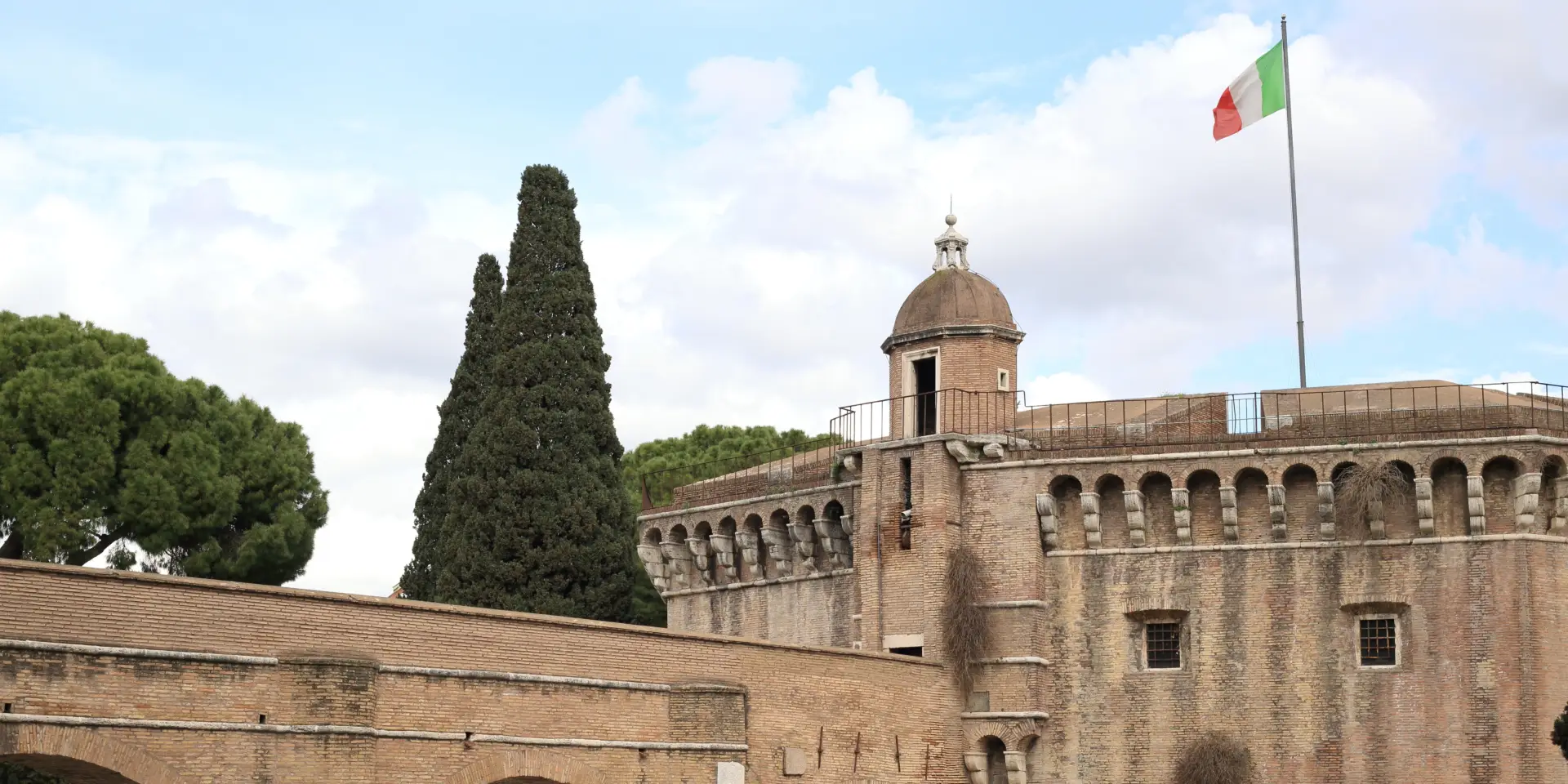
What to See in Castel Sant’Angelo: The Passetto
As you navigate Rome—whether by car or on foot—you may find yourself crossing streets and squares that, at first glance, seem to lack historical or artistic significance. Near Piazza Pia, one such road passes beneath a series of ancient-looking arches that many, at a glance, mistakenly assume to be remnants of a Roman aqueduct.
In reality, these arches belong to the Passetto di Borgo, a hidden passage connecting Vatican City to Castel Sant’Angelo. This discreet yet strategic corridor has been the setting of dramatic historical events, including escapes, sieges, and pivotal moments in Rome’s past. Known affectionately by Romans as “Er Coridore”, walking through the Passetto di Borgo is like stepping back in time, retracing the footsteps of popes and prisoners, all while enjoying breathtaking views of ancient and modern Rome as a backdrop to this extraordinary architectural marvel.
The Passetto di Borgo at Castel Sant’Angelo: What to See
The Passetto di Borgo, also known as the Passetto di Castel Sant’Angelo, is an elevated corridor that links the Bastione San Marco, embedded within the perimeter walls of Hadrian’s Mausoleum, to the Vatican, specifically the Apostolic Palace.
The earliest traces of this structure, in its most primitive form, date back to 547 AD as part of the defensive system surrounding the military camp of Totila, the king of the Ostrogoths.
Today, the Passetto di Borgo stands as an 800-meter-long fortified passage, featuring both an open panoramic section and a covered passageway. The narrowest part measures only 75 cm wide, allowing just one person at a time to pass through.
This corridor is actually the last remaining section of the Leonine Walls, built in the 9th century under Pope Leo IV to protect the Civitas Leonina and, most importantly, St. Peter’s Basilica from Saracen raids.
A few years later, during the renovation of the Vatican walls, an additional covered passage was added to the Passetto. The primary purpose of this addition was to provide a secret escape route for the pope in times of danger, allowing them to flee from the Vatican to Castel Sant’Angelo, which had by then been transformed from Hadrian’s Mausoleum into an almost impenetrable fortress.
However, the Passetto di Borgo was not only used as a papal escape route. It also served as a hidden passage for transferring prisoners to Hadrian’s Mausoleum, especially when secrecy was required. Few people know that the historical dungeons of Castel Sant’Angelo once held famous figures such as:
Count Cagliostro, the infamous alchemist and occultist
Benvenuto Cellini, the renowned goldsmith and sculptor
Giordano Bruno, the philosopher condemned for heresy
Beyond its role as an escape and prisoner transfer route, the Passetto also played a strategic military function. It allowed defenders to launch arrows from above onto enemy forces attacking the Borgo district, with special openings built along the walkway for this purpose.
There is some debate regarding the true architect of the Passetto. Some attribute its construction to Pope Nicholas III, who is credited with moving the papal residence from the Lateran Palace to the Vatican.
Restorations and Historical Events
Over the centuries, the Passetto di Borgo underwent several restorations, notably during the pontificates of Nicholas V, Sixtus IV, and Alexander VI in the 16th century.
In 1562, under Pope Pius IV, several new arches (fornici) were built in various locations, including:
Vicolo del Campanile
Vicolo del Farinone
Via del Mascherino
Vicolo delle Palline (named after the Medici emblem of Pius IV, engraved on Porta Angelica)
Via Porta Castello, which is separated from the new monumental gate by the Madonna della Misericordia (1953)
Vicolo d’Orfeo in Borgo Pio, where visitors can admire a beautiful 18th-century “Madonnella”, a wooden shrine topped with a triangular pediment
The final section of the Passetto di Borgo consists of eight large arches, stretching over the lush gardens of Parco Adriano, leading to the Bastione di San Marco. Along with three other corner towers, this bastion marks the Marcia Ronda, the fortified walkway surrounding Castel Sant’Angelo.
The Passetto’s Role in Historic Escapes and Sieges
A guided tour of the Passetto di Borgo reveals some of the most dramatic historical events that took place within its walls, including:
The Escape of Pope Alexander VI Borgia (1494): During the French invasion led by King Charles VIII, Alexander VI fled through the Passetto to take refuge in Castel Sant’Angelo.
The Sack of Rome (1527): One of the most infamous events in Rome’s history, this brutal attack saw Landsknecht mercenaries under Emperor Charles V lay siege to the city. Pope Clement VII, realizing he was in grave danger, fled through the Passetto.
According to legend, Clement VII was shielded by a black cloak, held over him by courtiers and nobles, in an attempt to conceal his white papal robes. He barely managed to reach Castel Sant’Angelo, narrowly dodging bullets fired by the German mercenaries—traces of these gunshots can still be seen on the Passetto’s walls today.
The Swiss Guard, however, was not as fortunate. In a heroic but tragic act, most of its members were slaughtered while trying to protect St. Peter’s Basilica.
A Unique Experience in Rome’s Hidden History
Visiting the Passetto di Borgo is a once-in-a-lifetime journey into the secrets of Rome’s past. This seemingly unremarkable structure conceals centuries of history, from papal intrigue and military strategy to dramatic escapes and fierce battles.
Today, the Passetto remains one of the most fascinating and overlooked sites in Rome, offering a rare chance to walk the same path as popes, prisoners, and defenders of the Eternal City.
Useful information
Address: Castel Sant’Angelo is located at Lungotevere Castello, 50, 00193 Rome, Italy, just a short walk from St. Peter’s Square and Rome’s historic center.
Opening Hours: The castle is open daily from 9:00 AM to 7:30 PM, with the last admission at 6:30 PM. Please note that the site is closed on January 1st, May 1st, and December 25th.
Ticket Office: To avoid queues at the entrance, it is highly recommended to purchase your ticket online.
How to Get There:
- By Metro: The nearest stations are Lepanto or Ottaviano (Line A), from which the castle can be reached with a short walk.
- By Bus: Lines 23, 40, 62, 271, and 280 stop nearby.
- By Tram: Line 19 stops at Risorgimento/San Pietro, just a few minutes’ walk from the castle
How to get there
From central Rome, the easiest way to reach the Passetto di Borgo is to aim for Castel Sant’Angelo and the Vatican walls. From Termini, take the metro to Ottaviano (Line A) and walk about 15 minutes along Via Ottaviano and Via di Porta Angelica, then follow signs toward St Peter’s Square. If you’re already by the river, cross Ponte Sant’Angelo and continue to Largo Giovanni XXIII; the covered corridor runs above Borgo streets between the Vatican and the castle. Taxis and ride-shares can drop you near Piazza Pia, a convenient starting point.
If you prefer buses or a tram, choose services that stop around Piazza Pia, Cavalleggeri/San Pietro, or near Castel Sant’Angelo, then follow your maps for the quickest approach to the walls. Wear comfortable shoes: sidewalks can be busy, and you’ll want time for photos of the bastions. Arrive early to avoid crowds, especially on weekends and during big events. Check your ticket time if you’re visiting Castel Sant’Angelo, because Passetto access is usually by guided tour with specific entry slots. Bring documents for security, look for the official entrance instructions, and pack water for summer heat and limited shade. Sunset walks here feel calm and cinematic.
History
The Passetto di Borgo is a raised, fortified corridor that links the Vatican to Castel Sant’Angelo, built to give popes a secure escape route in times of danger. Much of the structure is associated with Pope Nicholas III in the late 13th century, when the walls around the Borgo district were strengthened. Over the centuries, the passage became a symbol of the papacy’s need to balance spiritual authority with physical protection, weaving through Rome’s changing political storms. From the outside it looks like an ordinary stretch of wall, but inside it functioned like a hidden lifeline, elevated above the streets and guarded by the city’s defenses.
Its most famous moment came during the Sack of Rome in 1527, when Pope Clement VII fled through the corridor to the castle as imperial troops overwhelmed the city. Legends and chronicles describe a tense retreat while the Swiss Guard fought to slow the attackers near St Peter’s. Later popes continued to maintain and sometimes modify the route, keeping it ready for emergencies. Today, the Passetto survives as a rare piece of “living” fortification—part wall, part walkway, and part storybook reminder of how power, fear, and faith shaped the streets of Rome.
The Passetto di Borgo is a raised, fortified corridor that links the Vatican to Castel Sant’Angelo, built to give popes a secure escape route in times of danger. Much of the structure is associated with Pope Nicholas III in the late 13th century, when the walls around the Borgo district were strengthened. Over the centuries, the passage became a symbol of the papacy’s need to balance spiritual authority with physical protection, weaving through Rome’s changing political storms. From the outside it looks like an ordinary stretch of wall, but inside it functioned like a hidden lifeline, elevated above the streets and guarded by the city’s defenses.
Its most famous moment came during the Sack of Rome in 1527, when Pope Clement VII fled through the corridor to the castle as imperial troops overwhelmed the city. Legends and chronicles describe a tense retreat while the Swiss Guard fought to slow the attackers near St Peter’s. Later popes continued to maintain and sometimes modify the route, keeping it ready for emergencies. Today, the Passetto survives as a rare piece of “living” fortification—part wall, part walkway, and part storybook reminder of how power, fear, and faith shaped the streets of Rome.
Reviews
Leanne, United Kingdom
Mélanie , France
Argyrios, Greece
Gallery
Tips
Book the right experience in advance
Passetto access is often limited and usually offered only on scheduled guided visits. Reserve early, especially for weekends and high season, and double-check the meeting point and ID requirements. Arrive 15–20 minutes ahead for security checks and group organization. Late arrivals may miss entry.
Dress and pack for exposed walking
Even though it’s a historic corridor, the route can feel exposed to sun, wind, or drizzle. Wear comfortable shoes with good grip, bring water in warm months, and carry a light layer. Skip bulky bags to move easily through narrow sections and checkpoints along the path.
Time it for photos and quieter moments
For the best atmosphere, choose early morning or late afternoon. You’ll get softer light over Castel Sant’Angelo and the Vatican walls, plus smaller crowds. Keep your phone or camera ready, but respect guide instructions and barriers—some areas are delicate and strictly off-limits.
 English
  German
  French
  Spanish
  Portuguese
  Polish