
What to See in Castel Sant’Angelo: The Mausoleum of Hadrian
When thinking of a castle, one often envisions a medieval stronghold perched atop a hill, overlooking a valley. However, this is not always the case, and Castel Sant’Angelo in Rome is proof of that. Few people know the true history behind this imposing structure, which dominates the banks of the Tiber River.
Its origins date back to ancient times, as it was originally built to be the imperial mausoleum of Emperor Hadrian, only to later be transformed into a magnificent papal residence. Ghosts, daring escapes, and legendary prisoners have made Castel Sant’Angelo one of the must-see landmarks for anyone visiting Rome.
Castel Sant’Angelo: What to See
What we now call Castel Sant’Angelo was once known as the Mausoleum of Hadrian, or Mole Adriana, referring to its original purpose: to hold the ashes of Emperor Hadrian and his family. Commissioned by Hadrian himself and designed by Decrianus, it was constructed between 123 and 139 AD. Over time, it also became the final resting place for other Roman emperors, including Marcus Aurelius, Septimius Severus, Commodus, and Caracalla.
The fate of Hadrian’s Mausoleum changed in 1367, when it became property of the Church under Pope Urban V. It was during this time that prison cells were built, where notable figures such as Benvenuto Cellini, Count Cagliostro, and Giordano Bruno were later imprisoned.
During a guided tour of Castel Sant’Angelo, visiting the historic dungeons is an essential experience. One of the most famous cells is the “Cagliostra”, which, surprisingly, was relatively comfortable and elegantly furnished. These prison areas can be accessed via the Parlatoio, the interrogation and torture chamber, where instruments of torture and illustrations of the punishments inflicted on prisoners are on display.
Another infamous cell within Castel Sant’Angelo is the “Sammalò”, located behind the Bastione San Marco. This space was originally an air vent for the central hall, making it extremely narrow. Prisoners were lowered in from above, forcing them to remain permanently on their knees due to the lack of space.
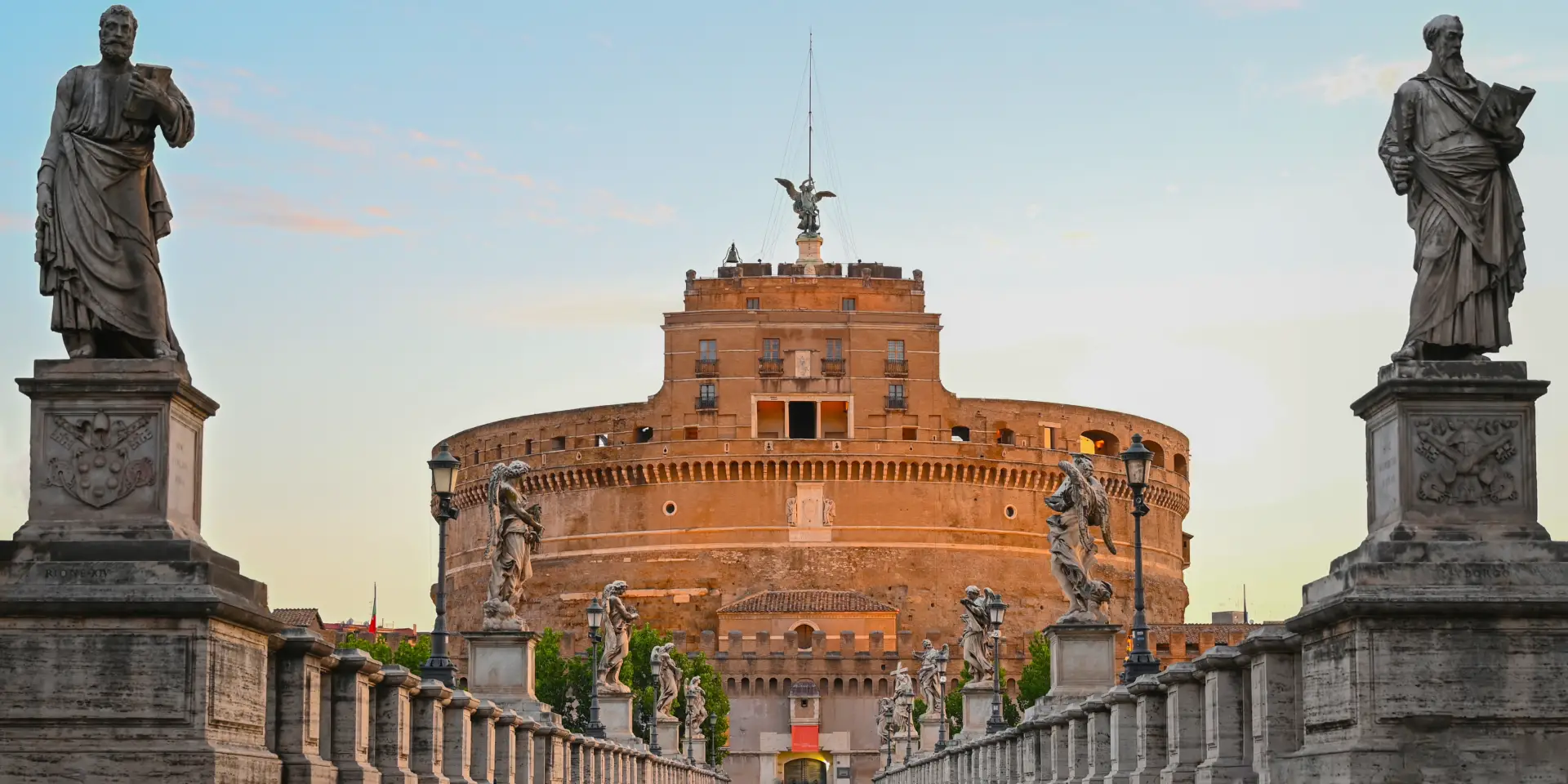
From the outside, Castel Sant’Angelo appears majestic, featuring a cubic base, a cylindrical upper structure, and the Marcia Ronda, a fortified walkway punctuated by the fortress’s four bastions. At the top of the tower stands the statue of an angel—a bronze sculpture dating back to 1753—which commemorates the apparition of the Archangel Michael during a plague epidemic that struck Rome in 590 AD.
According to Christian tradition, Pope Gregory the Great led a procession to pray for divine intervention to save the city. As they approached Ponte Elio (built in 134 AD), the pope had a vision of the Archangel Michael sheathing his sword, signaling that their prayers had been answered. The plague subsided, and the Mausoleum of Hadrian was renamed Castel Sant’Angelo. A statue of the archangel was then placed atop the highest terrace.
This panoramic terrace offers breathtaking views over Rome, from the Altare della Patria to St. Peter’s Basilica. In addition to the angelic statue, the terrace is also home to an 18th-century bell, which tolled before every execution carried out at the fortress.
A copy of the Archangel Michael statue, sculpted in 1544 by Raffaello da Montelupo, is located in the Cortile d’Onore. Here, visitors can also admire a 16th-century shrine designed by Michelangelo Buonarroti for the adjacent Chapel of Leo X, which houses one of the mausoleum’s most valuable artworks: the Madonna and Child by Raffaello da Montelupo.
The Most Beautiful Rooms Inside Hadrian’s Mausoleum
One of the most impressive architectural highlights of Castel Sant’Angelo is the Loggia of Julius II, featuring a marble parapet overlooking the Tiber River. This loggia leads directly into the sumptuous Sala Paolina, the state reception hall of Pope Paul III, lavishly decorated by Perin del Vaga with papal emblems, depictions of Hadrian, the Archangel Michael, and scenes from the life of Alexander the Great.
Another stunning space is the Sala dell’Apollo, a 15th-century chamber commissioned by Pope Nicholas V, which is adorned with frescoes of the god Apollo.
Greek mythology continues to play a major role in the Sala di Perseo (Hall of Perseus), whose walls depict scenes from Ovid’s “Metamorphoses”. Similarly, the Sala di Amore e Psiche (Hall of Cupid and Psyche)—which was Pope Paul III Farnese’s bedroom—features frescoes that capture the sensual beauty of Apuleius’ tale, particularly the moment Cupid flees after Psyche discovers his true identity.
A guided tour of Castel Sant’Angelo also includes a visit to the Sala del Castellano, where visitors can explore an extensive exhibit dedicated to La Girandola, the spectacular fireworks display that has taken place every June 29th since 1481.
Other must-see rooms include:
Sala della Giustizia (Hall of Justice): The chamber where Giordano Bruno was condemned to death.
Sala delle Urne (Hall of the Urns): The final resting place of the Roman emperors.
The Sala delle Urne is accessed through the Dromos corridor and a dark, spiral ramp. Unlike the other lavishly decorated rooms of Hadrian’s Mausoleum, this chamber is simple and solemn, with travertine walls, empty niches that once housed the urns, and an inscription bearing a quote from Emperor Hadrian himself.
A Must-See in Rome
Castel Sant’Angelo is not just a castle—it is a testament to Rome’s layered history, serving as an imperial tomb, a military fortress, a papal residence, and a prison. Whether you’re exploring its ancient dungeons, admiring Renaissance frescoes, or enjoying the breathtaking views from its terraces, this extraordinary monument offers a unique journey through time in the Eternal City.
Useful information
Address: Castel Sant’Angelo is located at Lungotevere Castello, 50, 00193 Rome, Italy, just a short walk from St. Peter’s Square and Rome’s historic center.
Opening Hours: The castle is open daily from 9:00 AM to 7:30 PM, with the last admission at 6:30 PM. Please note that the site is closed on January 1st, May 1st, and December 25th.
Ticket Office: To avoid queues at the entrance, it is highly recommended to purchase your ticket online.
How to Get There:
- By Metro: The nearest stations are Lepanto or Ottaviano (Line A), from which the castle can be reached with a short walk.
- By Bus: Lines 23, 40, 62, 271, and 280 stop nearby.
- By Tram: Line 19 stops at Risorgimento/San Pietro, just a few minutes’ walk from the castle
How to get there
To reach the Mausoleum of Hadrian (Castel Sant’Angelo), head to the area between the Tiber and St Peter’s. The simplest route is by Metro: take Line A to either Lepanto or Ottaviano, then Walk 12–18 minutes toward the Vatican. You’ll see the castle as you approach the Bridge of Sant’Angelo beside the River, a scenic approach that also passes statues and photo viewpoints. From the historic center, it’s an easy stroll from Piazza Navona (about 15 minutes) following signs to the Tiber.
If you prefer public transport, several Bus lines stop near Piazza Pia or along Lungotevere, placing you a few minutes from the main gate. From Termini, you can combine metro with walking, or take a direct Taxi to the Entrance for the fastest option. Arrive a little early if you have timed Tickets, because Security checks can create short queues. The site is generally Accessible, but the ramps and internal Elevators can be limited during busy hours, so allow extra time if needed.
History
The Mausoleum of Hadrian was commissioned by Emperor Hadrian around 123 AD as a grand dynastic tomb on the banks of the Tiber, deliberately set apart from the crowded city center. Completed under Antoninus Pius, it became the resting place for several Roman emperors and their families, a massive cylinder of marble and travertine crowned by gardens and statuary. Its original splendor has been stripped away, but the core structure still reveals the imperial ambition of the High Roman Empire: a monument designed to outlast time, proclaiming stability, wealth, and continuity.
As centuries passed, Rome’s needs changed, and the mausoleum transformed with them. In the 5th–6th centuries it was fortified, and by the medieval period it had become a strategic stronghold guarding the city’s northern approaches. It later evolved into Castel Sant’Angelo, linked to papal power and refuge, especially during moments of crisis. Tradition ties its name to a vision of the archangel Michael ending a plague, a story echoed by the statue on the summit. Under the popes, it served as fortress, residence, and even prison, its corridors holding political captives and dark memories. Today, visitors climb through layered architecture—tomb, fortress, palace—ending on the terrace with sweeping views, where ancient history and Renaissance Rome meet in one unforgettable silhouette.
The Mausoleum of Hadrian was commissioned by Emperor Hadrian around 123 AD as a grand dynastic tomb on the banks of the Tiber, deliberately set apart from the crowded city center. Completed under Antoninus Pius, it became the resting place for several Roman emperors and their families, a massive cylinder of marble and travertine crowned by gardens and statuary. Its original splendor has been stripped away, but the core structure still reveals the imperial ambition of the High Roman Empire: a monument designed to outlast time, proclaiming stability, wealth, and continuity.
As centuries passed, Rome’s needs changed, and the mausoleum transformed with them. In the 5th–6th centuries it was fortified, and by the medieval period it had become a strategic stronghold guarding the city’s northern approaches. It later evolved into Castel Sant’Angelo, linked to papal power and refuge, especially during moments of crisis. Tradition ties its name to a vision of the archangel Michael ending a plague, a story echoed by the statue on the summit. Under the popes, it served as fortress, residence, and even prison, its corridors holding political captives and dark memories. Today, visitors climb through layered architecture—tomb, fortress, palace—ending on the terrace with sweeping views, where ancient history and Renaissance Rome meet in one unforgettable silhouette.
Reviews
Giulia, Italy
Elena, Spain
Thomas, Germany
Gallery
Tips
Don’t rush the terrace and views
Save time for the top terrace, this is the payoff. From here you can spot St Peter’s dome, the Tiber bends, and rooftops across the historic center. Aim for late afternoon for softer light, and keep a light jacket for wind. Sunset views are memorable.
Plan for lots of stairs and walking
The route climbs steadily via long ramps and staircases, so wear comfortable shoes and pace yourself. Bring water, especially in warm months, and take short breaks at viewpoints. If you need accessibility support, check lift availability and allow extra time during peak hours.
Go early for calmer galleries
Arrive at opening time to enjoy the ramps, courtyards, and museum rooms before tour groups fill the corridors. You’ll move faster through ticket checks, get cleaner photos in the halls, and have more space on the terrace. Early visits also feel cooler in summer.
 English
  German
  French
  Spanish
  Portuguese
  Polish