
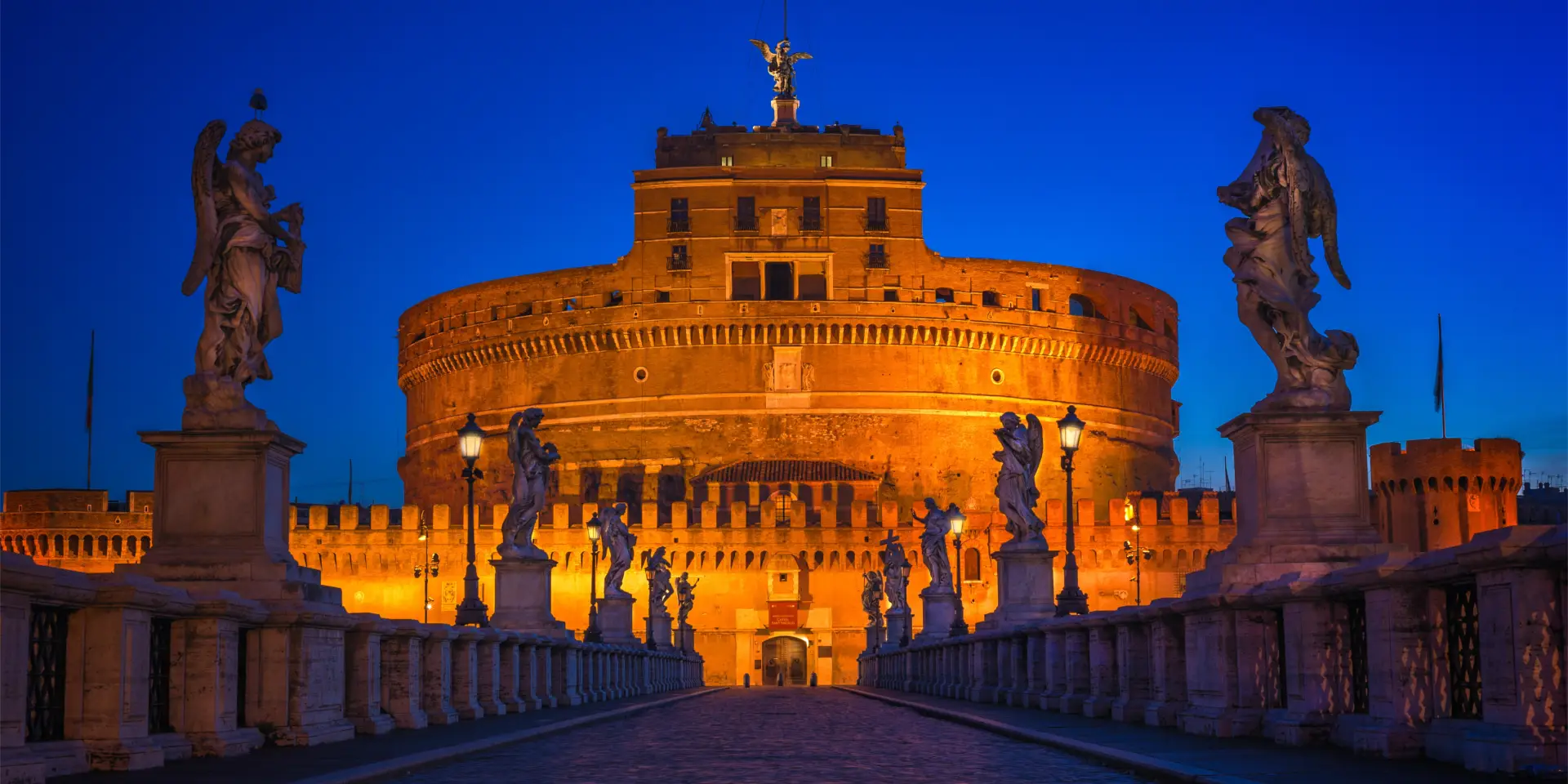

Visit castel sant'angelo in rome
If there is one place in Rome that embodies centuries of history, mystery, and charm, it is undoubtedly Castel Sant’Angelo. Located along the banks of the Tiber River, just a short walk from St. Peter’s Square, this imposing monument has witnessed the rise and fall of empires, transforming from an imperial mausoleum to a papal fortress, from a prison to a museum. Today, visiting it means immersing yourself in a journey through Rome’s past, admiring Renaissance frescoes, secret chambers, and a panoramic terrace offering one of the most breathtaking views of the Eternal City.
The history of Castel Sant’Angelo dates back to 135 AD, when Emperor Hadrian ordered the construction of a mausoleum for himself and his family. Over the centuries, its purpose changed dramatically: it became a military fortress, a refuge for popes during times of crisis, and even a feared prison. Many historical figures, including philosopher Giordano Bruno and painter Benvenuto Cellini, were imprisoned within its walls.
One of the most fascinating features of the castle is the Passetto di Borgo, a secret corridor that connects Castel Sant’Angelo to the Vatican. Several popes used this passage to escape during sieges, such as Pope Clement VII, who fled to safety in the castle during the Sack of Rome in 1527.
Inside, you will also find spectacular frescoed rooms, such as the Paolina Hall, adorned with Renaissance paintings celebrating papal power. Don’t miss the collection of ancient armor and weapons—a true delight for history and military enthusiasts.
One of the most memorable moments of your visit is undoubtedly the climb to the panoramic terrace. From here, you can take in sweeping views of Rome, the Tiber River, St. Peter’s Basilica, and the bridges connecting the city’s two banks. It’s the perfect spot for capturing stunning photos and admiring the Eternal City from a unique perspective.
Castel Sant’Angelo is one of Rome’s most visited landmarks, and long queues at the entrance are common, especially during peak season. Booking your ticket in advance is the best way to skip the lines and make the most of your experience. By purchasing online, you can choose between a skip-the-line ticket or a guided tour, allowing you to uncover the castle’s hidden secrets with the help of an expert.
Additionally, if you want to optimize your itinerary, consider purchasing a combo pass that includes other must-see attractions like the Colosseum or the Vatican Museums.
Castel Sant’Angelo is located at Lungotevere Castello, 50, just a few minutes’ walk from St. Peter’s Square and easily accessible by public transport. If you’re traveling by metro, the nearest stop is Ottaviano (Line A). Alternatively, buses 23, 40, 62, and 64 stop nearby.
Whether you’re a history lover, an art enthusiast, or simply looking for an unforgettable experience in Rome, Castel Sant’Angelo is a must-visit destination. Walk through its centuries-old walls, uncover ancient legends, and be captivated by a breathtaking view over the city.
Don’t leave anything to chance: book your ticket online now and get ready for a journey through time in the heart of the Eternal City!
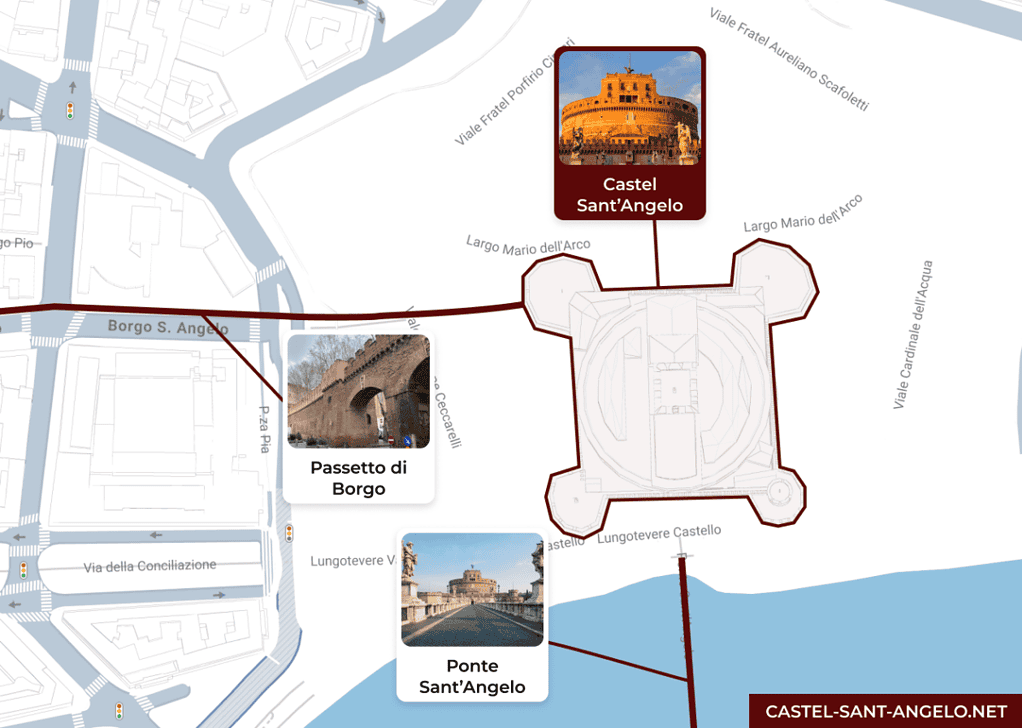
Castel Sant'Angelo map
Castel Sant’Angelo sits on the right bank of the Tiber River, between Rome’s historic center and Vatican City, just a short walk from St Peter’s Basilica. The fortress rises beside Lungotevere Castello and is reached by crossing Ponte Sant’Angelo, the elegant bridge lined with angel statues. Around it you’ll find riverside promenades, photo viewpoints, small cafés, and lively streets leading into the Borgo district. It’s also perfectly placed for combining with a Vatican visit.
Do you want to buy your online ticket to visit Castel Sant’Angelo?
Purchasing your Castel Sant’Angelo ticket online is the best way to avoid long queues and organize your visit efficiently. Follow these simple steps to secure your entry in just a few minutes!
Choose the type of ticket that suits you best:
- Standard entry ticket – Perfect for those who want to explore the castle independently or with an audio guide. BOOK NOW
- Guided tour ticket – Ideal for those who want to delve deeper into the history and secrets of the monument with an expert guide. BOOK NOW
- Combo passes – If you want to visit other attractions like the Colosseum or the Vatican Museums with a single ticket. BOOK NOW
By purchasing your ticket through our website, you will be using Tiqets.com, the official platform that offers the best prices and instant confirmation via email.
Vatican Museums: Fast Track Ticket + Castel Sant'Angelo
Take advantage of a great deal and secure access to two of Rome’s most visited attractions with a single combined ticket! With this option, you save on the price of individual tickets and find greater availability of dates and times, avoiding the risk of sold-out entries.
Discover the extraordinary masterpieces of the Vatican Museums and the Sistine Chapel, and be captivated by Michelangelo’s breathtaking frescoes. Then, take a stroll along the Tiber River and reach Castel Sant’Angelo, an ancient fortress offering a stunning panoramic view of the city.
HOW TO VISIT CASTEL SANT'ANGELO IN ROME
Castel Sant’Angelo is open every day, allowing visitors to explore its millennia-old history and enjoy its breathtaking view over Rome. Standard opening hours are from 9:00 AM to 7:30 PM, with the last admission one hour before closing. Please note that the castle is closed on January 1st, May 1st, and December 25th. During peak seasons, such as spring and summer, it’s highly recommended to book tickets in advance to avoid long waiting times. Occasionally, special events or evening openings are available, offering a unique experience to see the castle beautifully illuminated at night.
Castel Sant’Angelo is located in the heart of Rome, along the banks of the Tiber River, at Lungotevere Castello, 50. Its strategic position connects it directly to Vatican City via the Passetto di Borgo, an ancient secret passage used by popes to seek refuge in times of danger. The castle is just a short walk from St. Peter’s Square, as well as other famous landmarks like Piazza Navona and the Pantheon. Thanks to its central location, it is easily accessible on foot or by public transportation, making it a must-visit for anyone exploring Rome.
Reaching Castel Sant’Angelo is easy due to its central location. If traveling by metro, the closest stop is Ottaviano (Line A), from which you can take a 15-minute walk down Via della Conciliazione. Several buses stop nearby, including lines 23, 40, 62, and 64, making it convenient for those coming from the city center or Termini station. If you enjoy walking, the castle is less than 10 minutes from St. Peter’s Basilica and about 20 minutes from Piazza Venezia. Alternatively, you can also arrive by bicycle or take a scenic Tiber River cruise that stops near the monument.
The best time to visit Castel Sant’Angelo depends on your preferences. To avoid crowds, it is best to visit early in the morning right after opening or in the late afternoon. Spring and autumn provide mild temperatures and a pleasant atmosphere for exploring both the castle’s interior and its panoramic terrace. Summer months can be quite hot, but the castle offers shaded areas and cool indoor spaces. If available, an evening visit is an extraordinary experience, with the castle beautifully lit and an even more magical view over Rome.
The duration of your visit to Castel Sant’Angelo depends on your level of interest and the type of ticket chosen. A standard visit without a guide takes approximately 1.5 to 2 hours, allowing time to explore the frescoed rooms, museum exhibits, and the panoramic terrace. Opting for a guided tour may take 2 to 2.5 hours, as the guide provides fascinating details and historical insights. If you prefer to explore at a slower pace with an audio guide, your visit may last up to 3 hours. The best approach is to take your time and enjoy every corner of this historic treasure.
Since Castel Sant’Angelo is a historical monument, some areas may not be fully accessible to visitors with reduced mobility. The main entrance is accessible, but reaching the upper floors and panoramic terrace can be challenging due to narrow staircases and uneven floors. Elevators are available to provide access to certain sections, but it’s always best to check in advance for accessible routes or request assistance from the staff. Visitors with special needs are advised to book tickets in advance and inquire about the best options to make their visit as comfortable as possible.
USEFUL INFORMATION FOR YOUR VISIT
FAQ
It is not mandatory, but booking in advance is highly recommended, especially during peak tourist seasons. This allows you to skip long ticket lines and secure your entry without delays. Additionally, by purchasing online, you can choose from different options, such as a skip-the-line ticket or a guided tour.
The ticket price varies depending on the type of ticket you choose. The standard entry ticket has a fixed price, while options such as a guided tour or a combo pass with other attractions may have different rates. To check the updated prices and purchase your ticket online, CLICK HERE.
The duration of the visit depends on your level of interest and the type of experience you choose. On average, a self-guided visit lasts about 1.5 to 2 hours, but if you opt for an audio guide or a guided tour, you may need 2.5 to 3 hours. We recommend taking your time to explore the frescoed halls, museum exhibits, and enjoy the breathtaking panoramic terrace.
Due to its historical structure, accessibility may be limited in some parts of the castle. The main entrance is accessible, but reaching the upper floors and the panoramic terrace can be challenging due to narrow staircases and uneven surfaces. Elevators are available for some sections, so it is advisable to check in advance and request assistance if needed.
Inside the castle, you can explore a variety of fascinating historical areas:
- Ancient prisons and secret passages
- Paolina Hall, featuring spectacular Renaissance frescoes
- A collection of historical weapons and armor
- Passetto di Borgo, the secret passage connecting the castle to the Vatican
- The panoramic terrace, offering a stunning view of Rome and the Tiber River
If you want to uncover all the hidden details and stories of Castel Sant’Angelo, consider a guided tour, which will give you deeper insights and historical anecdotes. To check ticket availability and find the best option for your visit, CLICK HERE.
what to see in castel sant'angelo
Castel Sant’Angelo is one of the most fascinating monuments in Rome, a place that encapsulates centuries of history and transformation. From an imperial mausoleum to a papal fortress, from a prison to a museum, today it is an unmissable landmark for anyone visiting the Eternal City. Inside, visitors can discover frescoed rooms, ancient secret passages, art collections, and breathtaking views over Rome.
Entering the gates of Castel Sant’Angelo, you step into a labyrinth of halls, courtyards, and galleries, each revealing a different chapter of its long history. The structure is divided into multiple levels, each showcasing a part of its incredible past.
One of the most fascinating highlights is the National Museum of Castel Sant’Angelo, which houses a vast collection of weapons, paintings, sculptures, and historical artifacts related to the castle’s military and artistic past. Among the exhibition areas, the Collection Rooms stand out, displaying works of art and artifacts once owned by popes and noble families.
One of the most mysterious features of Castel Sant’Angelo is the Passetto di Borgo, the secret passage that connects the castle to the Vatican. This escape route was used by popes to flee in times of danger, such as during the Sack of Rome in 1527, when Pope Clement VII managed to take refuge inside the castle thanks to this elevated corridor.
The original structure was built as Hadrian’s Mausoleum, intended to house the remains of the emperor and his successors. A striking architectural element is the Helical Ramp, a monumental spiral passage that leads from the lower level to the heart of the mausoleum. This structure, designed to transport the emperors’ urns, allows visitors today to walk the same path once followed by imperial funeral processions.
During the Middle Ages and the Renaissance, Castel Sant’Angelo became a fortified residence for the popes. The Papal Apartments, adorned with magnificent Renaissance frescoes, reflect the opulence and power of the Church. Among these, the Chapel of Leo X is a hidden gem, featuring spectacular decorations commissioned by the Medici pope.
One of the most breathtaking parts of the visit is undoubtedly the Terrace of Castel Sant’Angelo, which offers a spectacular panoramic view of Rome. From here, you can spot St. Peter’s Square, the Tiber River, the Pantheon, and even the Colosseum. The terrace is also home to the statue of Archangel Michael, commemorating the legend that the angel appeared here in 590 AD to announce the end of a plague.
Descending from the upper levels, you reach the Courtyard of the Angel, where a statue of Archangel Michael stands—formerly placed at the top of the castle. This area was once used for ceremonies and military gatherings. A little further down, visitors can explore the prisons, where notable figures such as Benvenuto Cellini and Giordano Bruno were once imprisoned. The dark, cramped cells provide a stark reminder of Castel Sant’Angelo’s grim past as a place of detention.
After exploring the castle, it’s well worth visiting St. Peter’s Basilica and the Vatican Museums, which are just a short walk away. St. Peter’s Basilica is one of the most iconic landmarks in Rome, with its magnificent dome and the grand St. Peter’s Square. The Vatican Museums, on the other hand, house some of the greatest masterpieces of world art, including Michelangelo’s frescoes in the Sistine Chapel.
For a complete itinerary, consider taking a scenic walk along the Lungotevere, admiring historic bridges like Ponte Sant’Angelo, decorated with angel statues sculpted by Bernini. Another interesting stop is Piazza Navona, famous for its Baroque fountains and lively Roman atmosphere.
Castel Sant’Angelo is much more than just a castle—it is a place that tells the story of Rome through its walls, frescoes, and hidden secrets. To avoid long waits and make the most of your visit, it is highly recommended to book your ticket in advance, choosing between a standard entry or a guided tour to discover every fascinating detail of this historical masterpiece.

 English
  German
  French
  Spanish
  Portuguese
  Polish